How to Choose a Cervical Collar: Sizing, Types, and B2B Procurement Guide
Aug, 18 2026
In this article
A cervical collar (C-collar) limits neck movement after a suspected spinal injury. This guide covers the chin-to-shoulder finger-sizing method, the difference between rigid, adjustable, and soft collars, and the compliance points B2B buyers should check before sourcing—so EMS teams and distributors stock the right size every time.
What a Cervical Collar Actually Does
A cervical collar—often called a C-collar or neck brace—is a rigid or semi-rigid device that restricts movement of the cervical spine after trauma. In pre-hospital care it is applied during extrication and transport whenever a spinal injury cannot be ruled out: motor-vehicle crashes, falls, diving accidents, or blunt trauma above the clavicles.
The collar's real job is narrow but critical. It primarily restricts flexion (the chin dipping toward the chest) and limits extension; it does not "freeze" the neck. Rotational and lateral control comes from a head immobilizer and a spinal board used together with the collar. Understanding this split helps procurement teams buy the collar as part of a complete immobilization system, not as a standalone item.
Why Sizing Is the Real Dealbreaker
An incorrectly sized collar is worse than none at all. Too short, and it fails to stop flexion; too tall, and it drives the neck into hyperextension and can close the airway. Too loose, and it slides over the mouth and nose; too tight, and it compresses the carotid arteries. The field literature is blunt about this: a wrong size is a life-safety hazard, not a comfort issue.
A common misconception is that collar size tracks body height. It does not. A tall adult can have a short, thick neck; a small adult can have a long, slender one. The only reliable approach is to measure the patient at the scene—which is exactly why adjustable collars have become so popular with ambulance services.
The Finger-Measurement Method
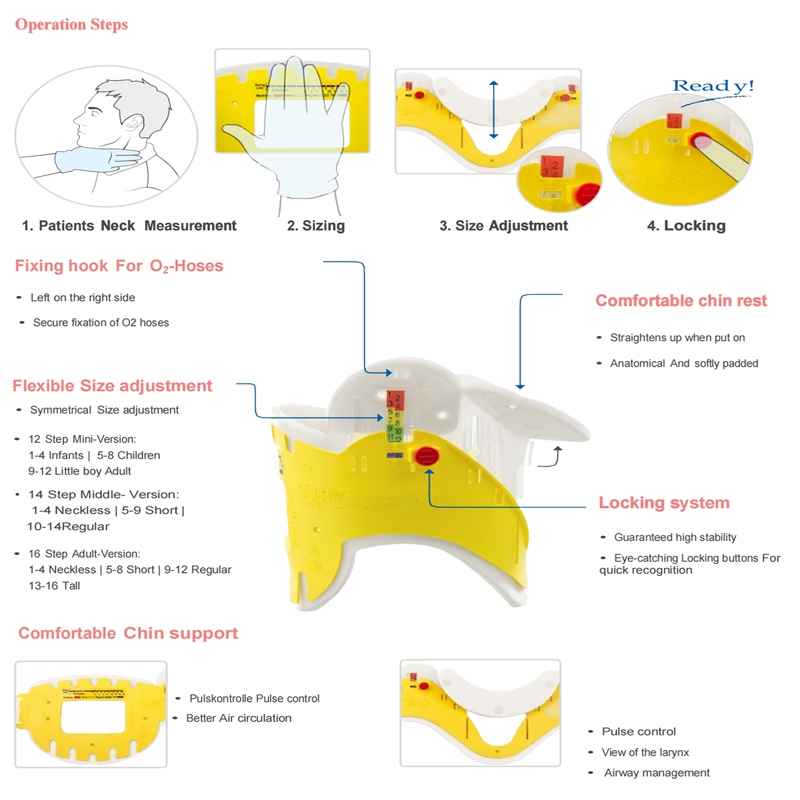
The field-standard technique needs no tape. With the patient's head in a neutral, eyes-forward position, the rescuer brings the fingers together as if saluting and rests the hand on top of the shoulder, pinky down. They draw an imaginary horizontal line from the bottom of the chin and count how many finger-widths of space sit between that line and the shoulder. That finger count maps to the collar height—or to the adjustment setting on an adjustable collar.
Manufacturers etch a sizing scale on the device itself, so the rescuer can match the measured gap before application. It is fast, reproducible, and works in low light—exactly what matters on a crash scene or in a dimly lit ward.
Rigid, Adjustable, or Soft?
Three categories dominate the market, and each suits a different buyer:
Rigid one-piece collars (Stifneck-style extrication collars) give maximum immobilization and are the pre-hospital standard for suspected fractures. They ship in fixed adult and pediatric sizes and are often color-coded for quick grab.
Adjustable (multi-size) collars replace several fixed sizes with one device that ratchets through many height settings. For ambulances and distributors, this cuts inventory dramatically—one SKU covers adult and pediatric ranges instead of four or five fixed collars.
Soft foam collars support muscle strain and minor stiffness but offer no meaningful protection against spinal movement. They belong in pharmacy and homecare channels, not trauma bags.
For emergency buyers, the practical mix is adjustable adult and mini collars plus a small stock of fixed rigid pediatric sizes.
What Procurement Should Verify
Beyond size, six checks protect a B2B order:
Latex-free construction — mandatory for allergy safety and tender compliance.
Radiolucent material — so CT and MRI are not blocked and the collar need not be removed for imaging.
Tracheal opening — a front aperture lets responders monitor the airway and carotid pulse.
Certifications — confirm ISO 13485 quality management, CE marking, and FDA listing on the manufacturer.
System compatibility — the collar should pair with the supplier's head immobilizer and spinal board so the kit works as one.
Single-use vs. reusable policy — decide per your infection-control protocol; many services discard after use.
Build the Full Immobilization Kit
A collar alone is incomplete. Spec it alongside a head immobilizer, a spinal board or scoop stretcher, and—for extremity fractures—air splints. Buying the set from one manufacturer simplifies documentation, training, and after-sales support, which is why many distributors prefer a single-source first-aid immobilization range rather than mixing brands.
Related Products
Adjustable Cervical Support Collar (TW5002)— adult and mini sizes for pre-hospital neck immobilization.View product →Adult Silicone Manual Resuscitator (TW8111)— emergency ventilation when breathing must be supported alongside spinal care.View product →Emergency Resuscitation Face Mask (TW8342)— one-way-valve CPR mask for safe rescue breathing.View product →Anti-Choking Suction Device (TW8648)— airway clearance for choking emergencies on the same response call.View product →
Why Partner With Tianzuo Medical
Xiamen Tianzuo Medical is a one-stop B2B medical supplier and a leading manufacturer of emergency, anesthesia, and respiratory products for pre-hospital, in-hospital, and homecare settings. Our first-aid immobilization line—including the adjustable cervical support collar, head immobilizers, and air splints—is engineered for the realities of EMS and crash-cart use.
We integrate R&D, molding, and production in-house, which is why OEM and ODM are our forte: distributors and private-label buyers can specify colors, sizing ranges, and packaging without juggling multiple vendors. Every order is backed by ISO 13485:2016 quality management, CE certification, and FDA listing, with full export documentation supplied for tender and cross-border shipments.
Whether you need a trial MOQ or a recurring bulk order, our factory supports wholesale and distributor programs with stable lead times. Talk to us about building a complete spinal-immobilization kit under one brand.
Inquiry now: visit our contact page or email Stephen@tzmed.com for quotes, catalogs, and OEM/ODM options.
Frequently Asked Questions
How do I measure a patient for a cervical collar?
With the head in a neutral position, measure the vertical gap between the bottom of the chin and the top of the shoulder—commonly done by counting finger-widths—then match that to the collar's sizing scale or adjustment setting.
Does collar size follow body height?
No. Neck length and thickness vary independently of height, so every patient must be measured at the scene rather than guessed from stature.
What is the difference between a rigid and an adjustable cervical collar?
Rigid one-piece collars give fixed maximum immobilization in set sizes; adjustable collars ratchet through many heights so one device covers adult and pediatric ranges and reduces distributor inventory.
Can a cervical collar alone immobilize the spine?
No. The collar mainly limits flexion and extension; rotational and lateral control requires a head immobilizer and spinal board used as a complete system.
What certifications should a B2B buyer require?
Look for ISO 13485 quality management, CE marking, and FDA listing on the manufacturer, plus latex-free construction and a radiolucent, tracheal-opening design for clinical use.