Disposable vs Reusable Anesthesia Breathing Circuits: Which Should You Choose?
Nov, 10 2026
Disposable vs Reusable Anesthesia Breathing Circuits: Which Should You Choose?
T
Published 2026-11-10 · By Tianzuo Medical Team
Facebook
LinkedIn
Instagram
YouTube
In this article
Choosing between disposable and reusable anesthesia breathing circuits is one of the most consequential OR procurement decisions you will make. In this guide we compare the two on infection control, cost-per-use, and workflow, then show how to match the circuit to your department's volume and sterilization capability.
What an anesthesia breathing circuit actually does
When single-use (disposable) circuits are the safer default
When reusable silicone circuits pay for themselves
A side-by-side decision table
How to match the circuit to your department's volume and sterilization setup
What an Anesthesia Breathing Circuit Actually Does
An anesthesia breathing circuit is the sterile conduit that links the anesthesia machine or ventilator to the patient's airway. It carries fresh oxygen and anesthetic gases toward the patient and returns expired CO2 to the scavenging system. A typical circuit is built from inspiratory and expiratory limbs, connectors, a Y-piece, a breathing bag, and often a bacterial filter or water trap—so every procurement decision around it is, at its core, a patient-safety decision. Clinically, circuits appear as simple Mapleson (semi-open) configurations for pediatrics or as circle (closed) systems for adult general anesthesia; both share the same core components and the same disposable-versus-reusable trade-off.
For OR managers and biomedical procurement teams, the first fork in the road is simple but consequential: should the circuit be single-use (disposable) or reprocessed for repeated use (reusable)? Both approaches are clinically valid. The right answer depends on your case volume, sterilization capacity, infection-control policy, and total lifecycle cost—not on the purchase price alone. The same disposable-versus-durable logic applies when you standardize manual resuscitators.
The TW8608 anesthesia breathing bag—the reservoir component that works with both disposable and reusable limb sets.
Disposable Circuits: Where Single-Use Is the Safer Default
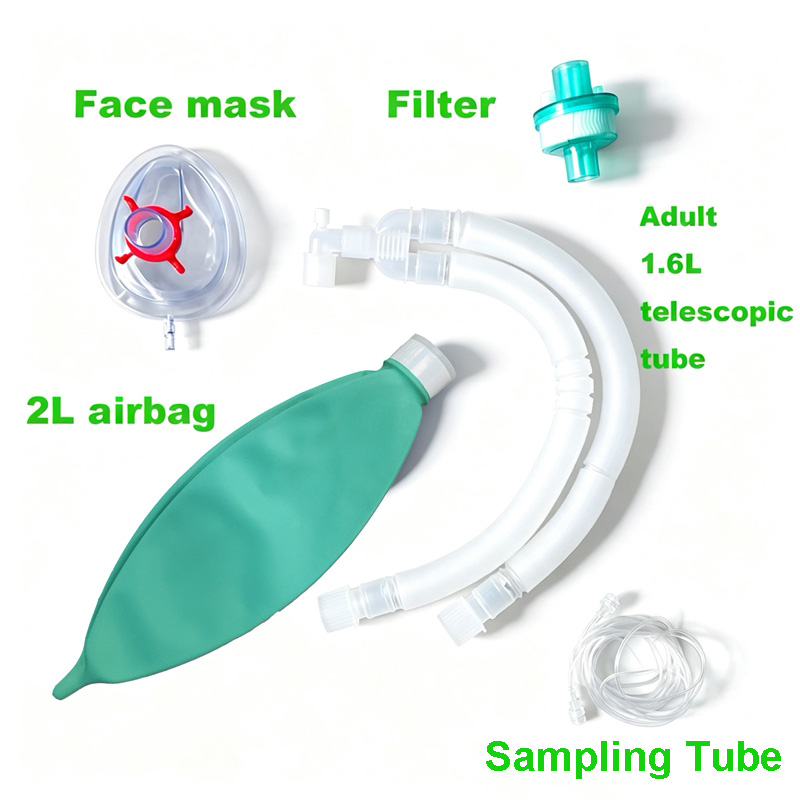
A disposable anesthesia breathing circuit—such as our latex-free, expandable Disposable Anesthesia Breathing Circuit—is supplied sterile, packaged for one patient or one defined clinical episode, and discarded afterward. Its dominant advantage is process simplification: there is no cleaning validation, no drying step, and no risk of residual contamination carried from the previous patient.
We routinely recommend disposable circuits for isolation cases, ambulatory and day-surgery units, primary hospitals without reliable sterilization infrastructure, and any department where rapid room turnover is the priority. They also remove reprocessing labor and the recurring cost of detergents and tracking systems, at the expense of a larger medical-waste stream—which is why high-volume centers often blend both approaches rather than commit to one.
A latex-free, expandable disposable breathing circuit—sterile, single-patient, and ready to use with no reprocessing burden.
Reusable Circuits: Where Reprocessing Pays Off
A reusable circuit—typically built from silicone or high-temperature polymers—is engineered to survive validated cleaning, disinfection, and sterilization cycles. In facilities with established reprocessing infrastructure and stable, high surgical throughput, the cost per use can drop dramatically versus disposables. Reusable systems also generate far less routine plastic waste, an increasingly important consideration for sustainability-driven procurement.
The responsibility shifts, however. Your team owns the entire reprocessing chain: disassembly, cleaning, drying, inspection, packaging, sterilization, and usage-cycle tracking. Any lapse—incomplete drying, incorrect chemical concentration, or damaged connectors—reintroduces cross-contamination risk. We advise reusable circuits only where a documented, audited reprocessing protocol already exists and staff compliance can be verified.
Disposable vs Reusable: The Decision at a Glance
The table below collapses the trade-offs procurement teams ask us about most often. Use it as a starting checklist, then validate each row against your own infection-control policy and throughput data before you standardize.
Evaluation factor
Disposable circuit
Reusable circuit
Infection controlLowest cross-contamination risk by designDepends on validated reprocessing
Cost modelRecurring per-procedure spendHigher upfront, lower per-use
Workflow & laborFaster room turnover, minimal laborCleaning, drying, inspection overhead
Environmental impactMore single-use wasteLess routine plastic waste
Best operational fitIsolation, ambulatory, low volumeHigh volume, audited sterilization
Read together, the pattern is consistent: single-use circuits move risk out of the reprocessing workflow and into recurring spend, while reusable circuits move risk into your sterilization discipline and reward it with lower per-procedure cost. Neither is universally superior—the decision is a balance of safety, throughput, and sustainability.
Matching the Circuit to Your Department and Volume
A practical way to choose is to map your reality against three variables. First, annual surgical volume: below roughly 1,000 cases, disposable circuits are usually the more economical choice; above 1,500 cases with validated reprocessing, reusable silicone circuits tend to win on lifecycle cost. Second, sterilization capability: if you lack reliable autoclave or ETO access, do not spec reusable circuits. Third, case profile: long, complex, or humidification-critical surgeries (pediatric, thoracic, neuro) benefit from reusable silicone circuits with water-collection cups, while short procedures and isolation cases favor disposables.
Whichever path you take, interoperability matters. The circuit must seat cleanly on ISO 5356-1 15 mm/22 mm connectors and pair with the mask, breathing bag, and airway device in your inventory. For the patient interface, a cushioned TW8374 PVC anesthesia mask with an ultra-soft cushion gives a reliable seal across adult and pediatric sizes, and a TW8608 anesthesia breathing bag integrates with both disposable and reusable limb sets.
The TW8374 PVC anesthesia mask with ultra-soft cushion—the patient-interface seal that pairs with any standard circuit.
When a supraglottic airway is indicated, our TW9111 non-inflatable cuff laryngeal mask (LMA) closes the loop without inflatable-cuff handling, keeping your circuit inventory simple and your OR setup predictable.
Related Products
Disposable Anesthesia Breathing Circuit
Expandable, latex-free, sterile single-patient circuit.
View product →
TW8608 Anesthesia Breathing Bag
Reservoir bag for disposable and reusable circuits.
View product →
TW8374 PVC Anesthesia Mask
Ultra-soft cushion, adult & pediatric sizes.
View product →
TW9111 Laryngeal Mask (LMA)
Non-inflatable cuff supraglottic airway device.
View product →
Why Partner With Tianzuo Medical
Xiamen Tianzuo Medical Co., Ltd. is a factory-direct manufacturer of anesthesia and respiratory devices, serving hospital procurement teams, distributors, and OEM/ODM partners across more than 30 markets. Our anesthesia product range—masks, breathing bags, circuits, airways, and LMAs—is built on ISO 13485:2016 quality management, with CE and FDA-listed documentation available per product line.
We support low minimum order quantities, private-label and customization programs, and consolidated shipping so you can standardize connectors and reduce SKU complexity across your OR. Every circuit, mask, and bag is 100% latex-free where specified and traceable by batch.
Ready to spec your next order? Contact our team or email Stephen@tzmed.com for a factory-direct quote and samples.
Frequently Asked Questions
Are disposable anesthesia circuits safer than reusable ones?
Disposable circuits eliminate patient-to-patient reprocessing risk by design, making them the safer default for isolation cases and facilities without audited sterilization. Reusable circuits are equally safe only when a validated, documented reprocessing protocol is followed consistently.
When do reusable breathing circuits become cost-effective?
Reusable silicone circuits typically pay for themselves in departments running above roughly 1,500 annual cases with established sterilization infrastructure. Below that volume, recurring disposable purchases are usually cheaper once labor and reprocessing overhead are included.
Do Tianzuo circuits fit standard anesthesia machine connectors?
Yes. Our disposable and reusable circuits, masks, and bags are built to ISO 5356-1 15 mm/22 mm connector standards, so they seat cleanly on mainstream anesthesia machines and ventilators.
Are your anesthesia products latex-free?
Our disposable circuit is specified latex-free, and our mask and airway range uses latex-free materials by design. Full material declarations and batch traceability are provided with each order.
Can Tianzuo supply OEM/ODM and low-MOQ orders?
Yes. We offer factory-direct OEM/ODM, private labeling, and low minimum order quantities across the anesthesia and respiratory catalog, with consolidated shipping to simplify your inventory.
Anesthesia Breathing Circuit
Disposable vs Reusable
OR Procurement