How to Choose a CPAP Mask: Full Face vs Nasal vs Nasal Pillow (2026 Buyer's Guide)
Aug, 27 2026
In this article
Choosing the right CPAP mask comes down to three things: how the patient breathes at night, how much facial coverage they will tolerate, and whether the seal holds at the prescribed pressure. This guide breaks down full-face, nasal, and nasal-pillow masks so B2B buyers can match the right style to the right user — and stock the range distributors actually ask for.
Why the Mask Type Matters as Much as the Machine
A CPAP machine only works if the interface delivers pressurized air without leaking. In practice, a poorly matched mask causes more therapy failure than a wrong pressure setting. Mouth breathing breaks a nasal seal overnight; a bulky full-face mask irritates claustrophobic users; high prescribed pressures need a more robust cushion than a minimal nasal pillow can hold. For a distributor or procurement manager, that means one size never fits all — the catalog has to cover the full spread of face shapes, sleeping positions, and prescription levels, or stockouts and returns pile up.
The Three Main CPAP Mask Types
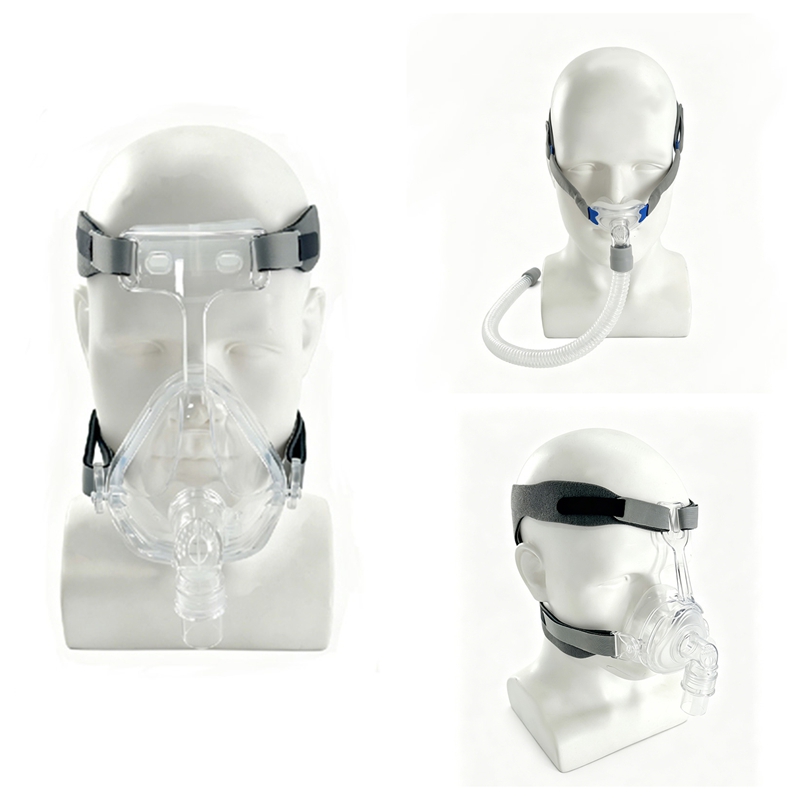
Full-face masks cover both nose and mouth. They are the default for mouth breathers, chronic nasal congestion, and higher pressure settings, because air has two exit paths if the seal is imperfect. The trade-off is more facial contact and more potential leak points around the perimeter.
Nasal masks seal around the nose only. They suit consistent nose breathers and feel less intrusive, with a wider field of vision for reading or watching TV. They fail the moment the mouth drops open, so some users need a chin strap to keep the seal intact.
Nasal pillow masks use small cushions that sit at the nostril openings. They are the lightest and least claustrophobic option — ideal for side sleepers, stomach sleepers, and glasses wearers — but they concentrate airflow directly at the nostrils and struggle at high pressures.
None of the three is universally "best." Each solves a different combination of breathing habit, face shape, and pressure need, which is exactly why a single SKU cannot serve every customer.
Matching a Mask to the User
Start with the breathing pattern. Mouth breathers at night should go straight to a full-face mask. Reliable nose breathers can use a nasal or nasal-pillow mask. Then weigh sleep position: side and stomach sleepers do best with the minimal contact of nasal pillows, while back sleepers tolerate bulkier full-face designs. Finally, check the prescribed pressure — higher settings generally need the larger sealing surface of a full-face or nasal mask rather than a pillow.
Comfort in the first two weeks drives long-term adherence, and adherence is what makes CPAP clinically effective. A good supplier expects first-mask mismatches and plans for exchanges; for a B2B buyer, that argues for stocking multiple styles and sizes rather than betting the whole order on one product.
Sizing, Fit, and the Procurement Checklist
Most CPAP masks ship in S/M/L (sometimes XL), and the right size depends on face width and nose-bridge shape, not body weight. When evaluating a supplier, look for soft, skin-friendly cushions; adjustable, low-marking headgear; clear sizing cues; and modular parts — cushions, frames, and headgear that can be reordered separately to extend product life and cut returns.
For wholesale buyers, the secondary checklist is commercial. Consistent sizing across the range, stable material quality (silicone cushion vs PC shell vs PVC), and private-label or OEM/ODM support matter as much as the mask itself. So do the certifications distributors need for tender and export: ISO 13485, CE, and FDA listing. A manufacturer that handles molding and assembly in-house also protects you from the supply gaps that appear when demand spikes.
Tianzuo Medical's CPAP Mask Range
Our CPAP lineup covers the three core styles so distributors can fill one sourcing relationship instead of several. The range includes half-face CPAP masks (TW8186 / TW8186B, sizes L/M), a nasal CPAP mask (TW8189, sizes L/M/S), a full-face silicone CPAP mask (TW8190-L, adult), and a PVC CPAP mask (TW8187, sizes L/M/S). Options span PC shell, silicone cushion with or without pad, and forehead-support variants — letting you match comfort tier to price point across different markets without multiplying suppliers.
Related Products
PVC Anesthesia Masks with Ultra-Soft Cushion— soft-seal airway interface for OR and ventilation use.View product →Emergency Resuscitation Mask with One-Way Valve— CPR and rescue-breathing protection with a filtered valve.View product →Adult Silicone Manual Resuscitator— reusable BVM for pre-hospital and ICU ventilation.View product →SEBS Manual Resuscitator— latex-free, cold-resistant resuscitation bag for single-patient use.View product →Portable Suction Device— airway clearance for emergency and transport settings.View product →
Why Partner With Tianzuo Medical
Xiamen Tianzuo Medical is a one-stop manufacturer integrating R&D, molding, and production, with OEM and ODM services as our forte. Our quality system is certified to ISO 13485:2016, products carry CE certification and are FDA-listed, and our team drafted China's *Guidelines for the Technical Review of Manual Resuscitator Registration*. For distributors and procurement teams we offer stable bulk supply, competitive MOQ, private-label and custom-mold options, and full export documentation. Whether you need a single CPAP style or a complete respiratory catalog, we ship directly from the factory. Contact us today at our inquiry page or email Stephen@tzmed.com to request a quote, samples, or a distributor agreement.
Frequently Asked Questions
Which CPAP mask is best for mouth breathers?
A full-face mask, because it covers both nose and mouth and keeps the seal even when the mouth opens during sleep.
Can a nasal mask be used if the patient breathes through the mouth?
Only with a chin strap to keep the mouth closed; otherwise air leaks and therapy drops, so a full-face mask is usually the safer choice.
Are nasal pillow masks suitable for high CPAP pressure?
They can feel uncomfortable at high pressures because airflow is concentrated at the nostrils; full-face or nasal masks handle higher settings better.
How often should CPAP mask cushions be replaced?
Typically every 3–6 months depending on use and wear; offering replacement cushions separately reduces returns and builds repeat B2B orders.
Do Tianzuo CPAP masks support OEM and private label?
Yes. As a manufacturer we provide OEM/ODM, private-label, and custom-mold options with CE, ISO 13485, and FDA-listed documentation for export and tender.