Venturi Mask vs Non-Rebreather Mask: Which Oxygen Delivery Device Should You Choose?
Sep, 03 2026
In this article
A Venturi mask delivers a fixed, precise FiO₂ (typically 24–60%) for controlled oxygen therapy, while a non-rebreather mask pushes near-100% oxygen from a reservoir bag for emergencies. This guide explains how each works, where they fit clinically, and what to specify when procuring them for your facility.
What Each Device Actually Does
Oxygen masks look similar on the shelf, but a Venturi mask and a non-rebreather mask solve opposite problems. The Venturi is a controlled-delivery device built for patients who must not receive too much oxygen — most famously people with COPD, where over-oxygenation can suppress respiratory drive and trigger CO₂ retention. The non-rebreather is a high-output rescue device: it floods the airway with the highest concentration a mask can deliver, and it is meant for minutes to hours, not days.
If you stock only one type, you will eventually face a patient who needs the other. That is why most procurement lists for hospitals, EMS services, and even well-equipped clinics carry both.
Venturi Mask: Precision When Control Matters
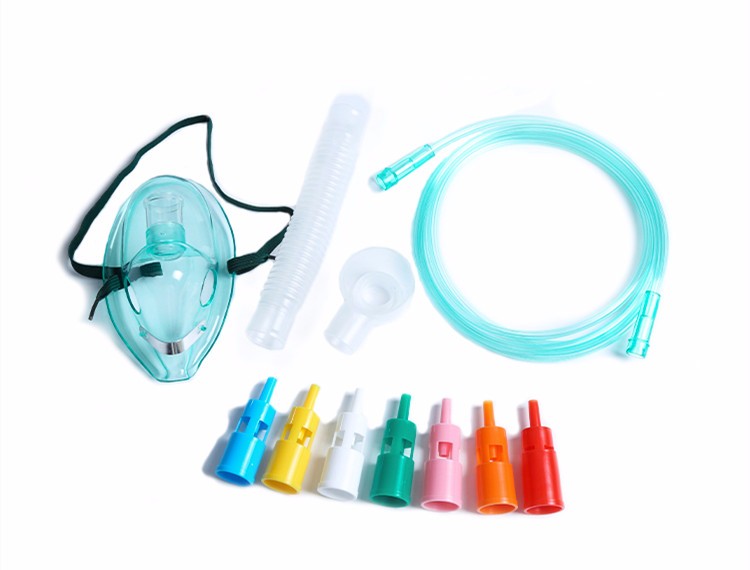
The Venturi mask earns its name from the Venturi effect. A small, color-coded jet forces oxygen through a narrow orifice at speed; that fast stream pulls in a measured amount of room air through side ports. Swap the adapter (or turn the dial on adjustable models) and you set a fixed FiO₂ — commonly 24%, 28%, 31%, 35%, 40%, or 60% — almost regardless of how the patient breathes.
For a buyer, the practical specs are:
FiO₂ range: roughly 24–60%, set by adapter.
Flow rate: around 4–12 L/min depending on the selected concentration.
Key safety feature: an anti-asphyxia valve that keeps air moving if the oxygen supply drops.
Because the delivered concentration barely drifts with the patient's tidal volume, the Venturi is the device respiratory therapists reach for when "close enough" is not safe. Target saturations for hypercapnia-risk patients typically sit at 88–92%, and only a fixed-FiO₂ device holds that line reliably.
Non-Rebreather Mask: Maximum Oxygen, Fast
A non-rebreather mask pairs a tight-fitting face mask with a reservoir bag and one-way valves. On inhalation the patient draws from the bag; on exhalation the valves route spent gas away so almost none is rebreathed. Run at 10–15 L/min with the bag kept at least partly inflated, it can deliver up to roughly 90–100% oxygen.
This is the mask for the trauma bay, the ambulance, and the cardiac-arrest lineup. It is the fastest way to buy time before intubation or mechanical ventilation. But it is a short-term tool: clinicians are taught not to leave a patient on a non-rebreather beyond about 24 hours, and anyone who needs that much oxygen for longer belongs on a ventilator or high-flow system.
Venturi vs Non-Rebreather: The Key Differences
| Factor | Venturi Mask | Non-Rebreather Mask |
| FiO₂ control | Fixed, precise (24–60%) | High but variable (up to ~100%) |
| Typical flow | 4–12 L/min | 10–15 L/min |
| Best use | Controlled therapy, COPD | Emergency, severe hypoxia |
| Duration | Long-term / ongoing | Short-term only |
| Safety valve | Anti-asphyxia valve | One-way reservoir valves |
The headline difference is control versus output. A Venturi mask answers "exactly how much?" A non-rebreather answers "as much as possible, now."
When to Reach for Each One
Reach for the Venturi when the patient is at risk of hypercapnic respiratory failure — known or suspected COPD, a long-term smoker with chronic breathlessness, or a post-op patient with compromised lungs. Start low (24% at 2–3 L/min, or 28% at 4 L/min) and titrate against blood gases.
Reach for the non-rebreather for major trauma, shock, anaphylaxis, CPR, carbon monoxide poisoning, or any critically ill patient until reliable saturations are confirmed. Set the target at 94–98% in that group. One hard rule: do not put a non-rebreather on a COPD patient in steady state — the uncontrolled concentration can precipitate the very failure you are trying to avoid.
Common Procurement Mistakes Buyers Make
Buying on price per unit alone. A mask that fogs, leaks, or has a sticky valve costs more in wasted oxygen and clinician time than the few cents saved.
Forgetting adapters. Venturi masks are useless without the full color-coded adapter set; confirm the kit includes every concentration you stock.
Ignoring strap and cushion quality. Transparent, soft-cushioned masks improve fit and patient tolerance, which directly affects delivered FiO₂.
Skipping the reservoir check. For non-rebreathers, verify the bag inflates and the valves seat correctly out of the box.
No MOQ planning. Emergency stockouts are expensive; align minimum order quantities with your consumption rate and reorder lead time.
The simple rule for any buyer: carry both, train staff on when each applies, and treat mask quality as a clinical specification rather than a commodity line item. A ventilation decision made in seconds depends on the device in your hand working exactly as labeled.
Related Products
PVC Anesthesia Masks with Ultra-Soft Cushion (TW8374)— soft-seal masks for OR and respiratory circuits.View product →Resuscitation Mask with One-Way Valve, Emergency Face Mask (TW8342)— barrier protection for mouth-to-mask ventilation.View product →Adult Silicone Manual Resuscitator (TW8111)— reusable, autoclavable BVM for emergency ventilation.View product →Adult PVC Manual Resuscitator / Ambu Bag (TW8311)— cost-effective disposable BVM for pre-hospital use.View product →
Why Partner With Tianzuo Medical
Xiamen Tianzuo Medical is a one-stop manufacturer integrating R&D, molding, and production of emergency, anesthesia, and respiratory consumables. Our facility runs under ISO 13485:2016 with CE and FDA-listed status, and our team helped draft China's technical review guidelines for manual resuscitators — a measure of how seriously we treat airway safety.
For distributors, tender buyers, and procurement managers, we are built for volume: OEM and ODM are our forte, with private-label options, flexible MOQ, and bulk-order pricing backed by export documentation. Whether you need a container of BVMs or a mixed respiratory bundle for a tender, we ship as a single B2B medical supplier partner rather than a patchwork of vendors.
Ready to specify your next order? Contact our team at https://www.tianzuomedical.com/contact-us or email Stephen@tzmed.com for a quote, sample request, or catalog.
Frequently Asked Questions
What is the main difference between a Venturi mask and a non-rebreather mask?
A Venturi mask delivers a fixed, precise FiO₂ (about 24–60%) for controlled therapy, while a non-rebreather mask delivers the highest possible oxygen (up to ~100%) from a reservoir bag for emergencies.
When should I use a Venturi mask instead of a non-rebreather?
Use a Venturi mask for patients at risk of CO₂ retention, especially known or suspected COPD, where target saturations of 88–92% must be held precisely.
Can a non-rebreather mask be used long term?
No. It is a short-term rescue device; clinicians avoid using it beyond roughly 24 hours, after which the patient typically needs intubation, mechanical ventilation, or a high-flow system.
What flow rate should a non-rebreather mask run at?
Usually 10–15 L/min with the reservoir bag kept at least partially inflated, so the patient always draws from oxygen rather than room air.
Do Venturi masks need special adapters?
Yes. They use color-coded adapters (or an adjustable dial) that set the FiO₂; confirm the full adapter set is included when procuring, or the mask cannot deliver its precise concentrations.