Air Splint vs Plaster Cast: Which Immobilization Device Should You Choose?
Sep, 08 2026
In this article
An air splint (pneumatic splint) immobilizes a fractured or sprained limb by inflating a transparent sleeve around it, giving EMS and first responders a fast, adjustable alternative to a rigid plaster cast. This guide compares the two, explains when each belongs in pre-hospital care, and covers what distributors should look for when sourcing wholesale pneumatic splints.
What Is an Air Splint (Pneumatic Splint)?
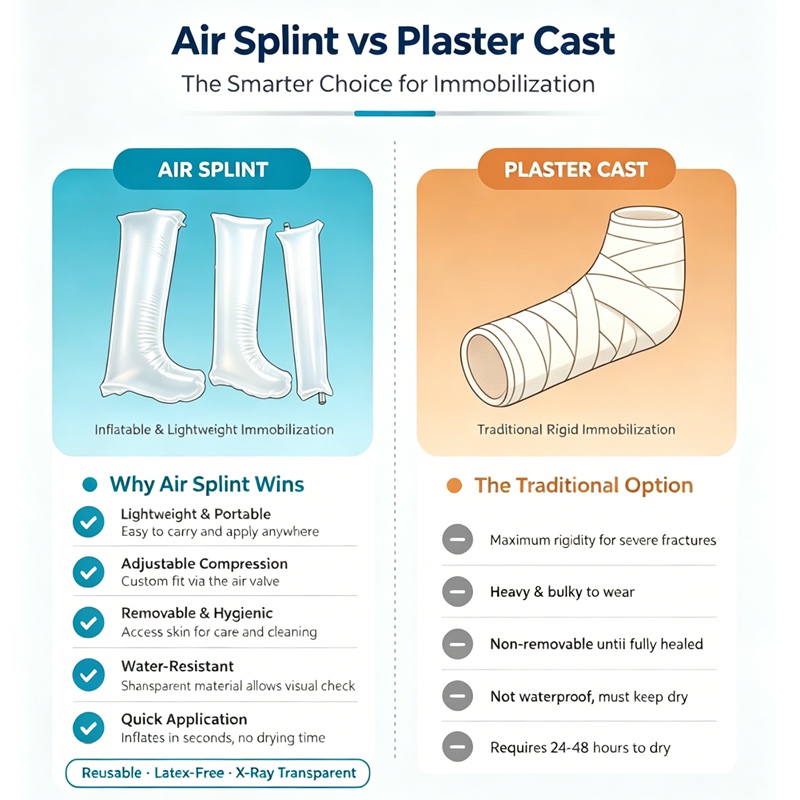
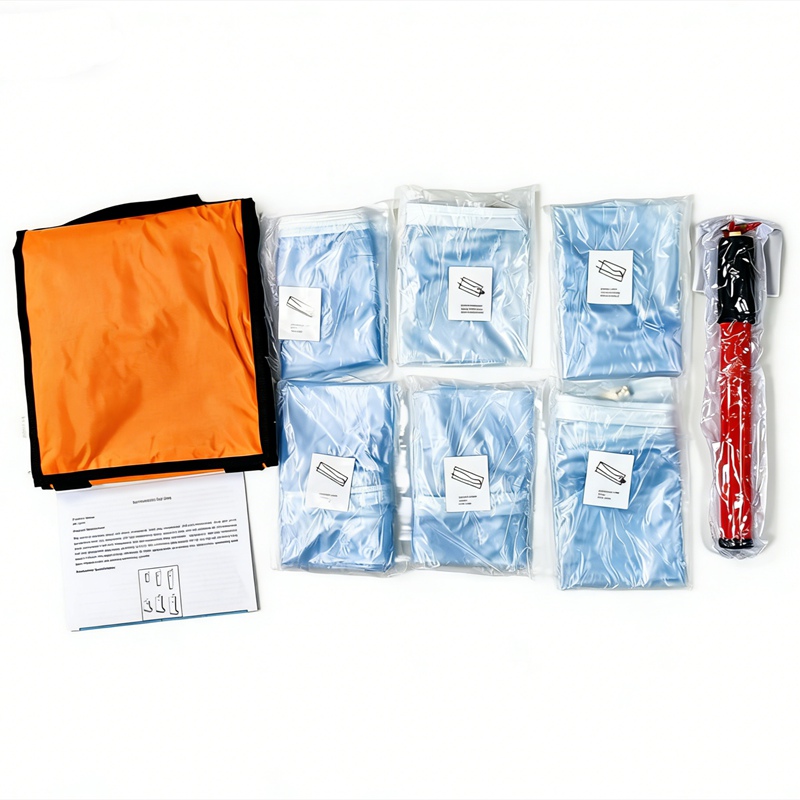
An air splint is a double-layered plastic sleeve shaped to fit a specific extremity — arm, forearm, leg, ankle, or foot. In its deflated state it lies flat and packs into almost any first-aid kit. On scene, you slip it over the injured limb, position it, and inflate by mouth through a one-way valve until it is firm but not tight. The trapped air applies even, circumferential compression that holds the limb still during transport.
Two features make it distinct from a cast. First, the material is transparent, so a responder can watch skin colour and check circulation underneath without removing it. Second, it is non-circumferential in spirit: unlike plaster, which fully encases the limb and cannot be adjusted, an air splint tolerates swelling because you simply add or release a little pressure. That matters most in the first hour after an injury, when tissue edema is still building and a rigid cast would risk cutting off blood flow.
Air Splint vs Plaster Cast: The Core Differences
A plaster or fiberglass cast is a definitive device applied in a clinic for the weeks-long healing of a stable fracture. It wins on structural security — there is no stronger way to hold bone fragments in alignment. Its trade-off is rigidity: it cannot be loosened, it must stay dry, and it assumes the swelling has already settled.
An air splint is a field device, not a replacement for a cast. It is lighter, faster to apply, and removable in seconds once deflated. It suits the chaotic, time-pressured window between injury and hospital. The compromise is that it offers less absolute support and is physically fragile — a puncture deflates it. For procurement teams building an EMS bag or crash cart, the two are not competitors so much as different layers of the same care pathway: pneumatic splints for stabilization en route, casts for the recovery that follows.
When to Use an Air Splint in Pre-Hospital Care
Reach for a pneumatic splint whenever you must move a patient with a suspected fracture or severe sprain and you cannot yet rule out a break. Field protocols lean on the rule "if you can't rule out a fracture, treat it like one." Air splints excel in:
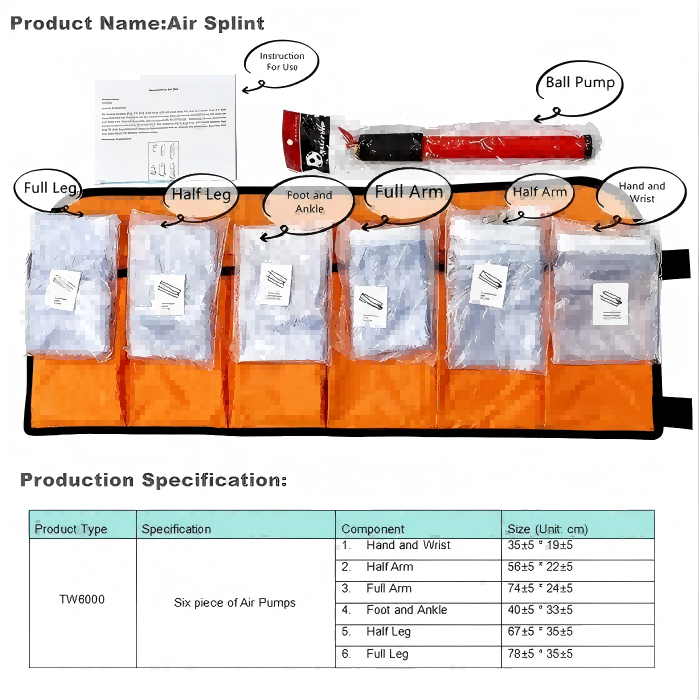
Limb transport: forearm, wrist-through-elbow, lower-leg, and foot-and-ankle injuries where you need compression without a full cast.
Swelling scenarios: because pressure is adjustable, you can re-check and ease the splint if fingers or toes start to pale — something a cast cannot do.
Remote and prolonged carries: flat-packed sleeves weigh little and take no space, which is why outdoor, military, and ambulance services keep them on hand.
Monitoring needs: the transparent wall lets you track circulation continuously through the window of transport.
When a Cast (or Rigid Splint) Is the Better Call
A pneumatic splint is the wrong tool for definitive fixation. Choose a rigid option — plaster, fiberglass, aluminium-foam, or a traction splint — when:
The fracture needs long-term, unyielding alignment that only a hard shell provides.
You are managing a mid-shaft femur break, where a traction splint counters muscle spasm and shortening.
The patient will fly: altitude drops ambient pressure, so an inflated air splint must be partially deflated to avoid over-squeezing the limb — a cast has no such problem.
Also remember the classic hazard of any inflatable device: over-inflation can choke off blood supply or, in the worst case, contribute to acute compartment syndrome. Train responders to inflate to firm-but-not-tight and to re-check distal pulse, sensation, and colour after application.
How to Apply an Air Splint: Step-by-Step
Clear the ABCs first. A fracture is rarely the only injury; confirm airway, breathing, and circulation before you touch the limb.
Document baseline status. Check pulse, sensation, and skin colour below the injury, and write it down.
Expose, don't pull. Cut clothing away rather than dragging it over the wound. Cover any open fracture with a sterile dressing first.
Slide on the deflated sleeve in the position you find the limb — never straighten a deformed extremity unless circulation is compromised and help is far away.
Pad bony points (wrist, ankle, elbow) with gauze so the plastic does not bite.
Inflate by mouth to firm-but-not-tight. You should still be able to slide a finger between splint and skin at the edges.
Re-check circulation immediately. If the pulse weakens or the extremity goes blue, release pressure and re-inflate softer.
What Buyers Should Look for in a Wholesale Air Splint
If you procure for an ambulance service, distributor, or tender, the splint itself is only half the decision. Look for a supplier that runs an ISO 13485:2016 quality system and holds CE and FDA-listed documentation, because those certificates travel with your export paperwork and shorten customs reviews. Confirm the valves seat cleanly and the seams are welded, not glued — a slow leak on a three-hour transport is a failure you do not want.
For private-label programs, ask about OEM and ODM: can the manufacturer mould your size markings, print your brand, and bundle arm/leg/foot variants into one SKU kit? MOQ and lead time decide whether a small distributor can stock a full range or must start with a single high-turnover size. As a one-stop manufacturer integrating R&D, molding, and production, Tianzuo Medical builds immobilization and airway consumables on the same line, which lets procurement consolidate orders and cut per-shipment freight.
Related Products
Adjustable Cervical Support Collar (TW5002)— pair pneumatic limb splints with cervical immobilization for full trauma stabilization.View product →Resuscitation Mask with One-Way Valve (TW8342)— standard crash-cart CPR protection for the same pre-hospital bag.View product →Adult Silicone Manual Resuscitator (TW8111)— reusable silicone BVM for emergency ventilation.View product →Adult PVC Manual Resuscitator / Ambu Bag (TW8311)— cost-effective disposable-class BVM for bulk EMS stocking.View product →Choke Suction Device (TW8648)— airway-clearance device that rounds out the pre-hospital emergency kit.View product →
Why Partner With Tianzuo Medical
Xiamen Tianzuo Medical Co., Ltd. is a leading B2B medical supplier of emergency, anesthesia, and respiratory products for pre-hospital, in-hospital, and homecare settings. We integrate R&D, molding, and production under one roof, which makes OEM and ODM our forte — private-label splints, masks, and resuscitators are built to your specification, not pulled from a generic catalogue. Every production line runs on an ISO 13485:2016 quality system, with CE and FDA-listed documentation supplied for export and tender submission.
For distributors and procurement managers, that translates into flexible MOQs, consolidated bulk orders across our immobilization and airway ranges, and export paperwork that clears customs without surprises. Whether you run an EMS fleet, a hospital tender, or a regional wholesale business, our team supports low-MOQ pilot runs and full-container repeat orders alike.
Ready to build your pre-hospital kit? Contact our team at https://www.tianzuomedical.com/contact-us or email Stephen@tzmed.com to request a quote, technical datasheets, and OEM/ODM options.
Frequently Asked Questions
What is the difference between an air splint and a plaster cast?
An air splint is an inflatable field device used to stabilize a limb during transport; a plaster cast is a rigid clinic-applied device for weeks-long fracture healing. The splint is adjustable and removable, the cast is fixed and definitive.
When should you use a pneumatic splint instead of a rigid splint?
Use a pneumatic splint in pre-hospital care when you need fast, adjustable immobilization and expect swelling, or when transporting a patient to hospital. Use a rigid splint or cast when the fracture needs long-term, unyielding alignment.
Can an air splint be used for a broken leg?
Yes, for lower-leg (tibia/fibula) and foot-and-ankle fractures a full-leg or foot-and-ankle air splint provides transport stabilization. It is not a substitute for a definitive cast, and mid-shaft femur breaks need a traction splint instead.
Do air splints need to be deflated before a patient flies?
Yes. Cabin pressure drops with altitude, which can over-inflate the sleeve and over-squeeze the limb. Partially deflate the splint before flight and re-check circulation on landing.
What certifications should a wholesale air splint supplier have?
Look for ISO 13485:2016 quality management, plus CE and FDA-listed documentation. These certificates support export compliance and tender eligibility, and a manufacturer offering OEM/ODM helps you private-label the product.