

How to Choose an Anesthesia Mask: A Practical Guide to Size, Cushion, and Material


Author
Experience the Xiamen Tianzuo Medical difference – where every product is a testament to our dedication to health and safety.
Tianzuo Medical


Summary: An anesthesia mask is the interface that turns gas delivery into a sealed, controllable airway—yet a poorly sized or stiff mask leaks anesthetic agent, pressures the face, and slows induction. This guide walks anesthesia buyers, OR nurses, and distributors through the decisions that actually affect performance: matching mask size to the patient (neonate to large adult), choosing between PVC single-use and silicone reusable cushions, what the 22 mm connector and transparent dome buy you, and how to vet a manufacturer's QC and documentation for tenders.
Why the Anesthesia Mask Still Matters
Even with supraglottic airways and video laryngoscopes, the face mask is the first and last interface in airway management—preoxygenation before induction, ventilation between intubation attempts, and recovery-room oxygenation. A mask that seals at low contact pressure preserves your target FiO₂ and volatile concentration, limits waste anesthetic gas in the OR, and reduces facial pressure marks during long cases. For procurement teams, that means the cheapest mask on the quote is rarely the cheapest over a year of leaky inductions and wasted agent.
Getting the Size Right
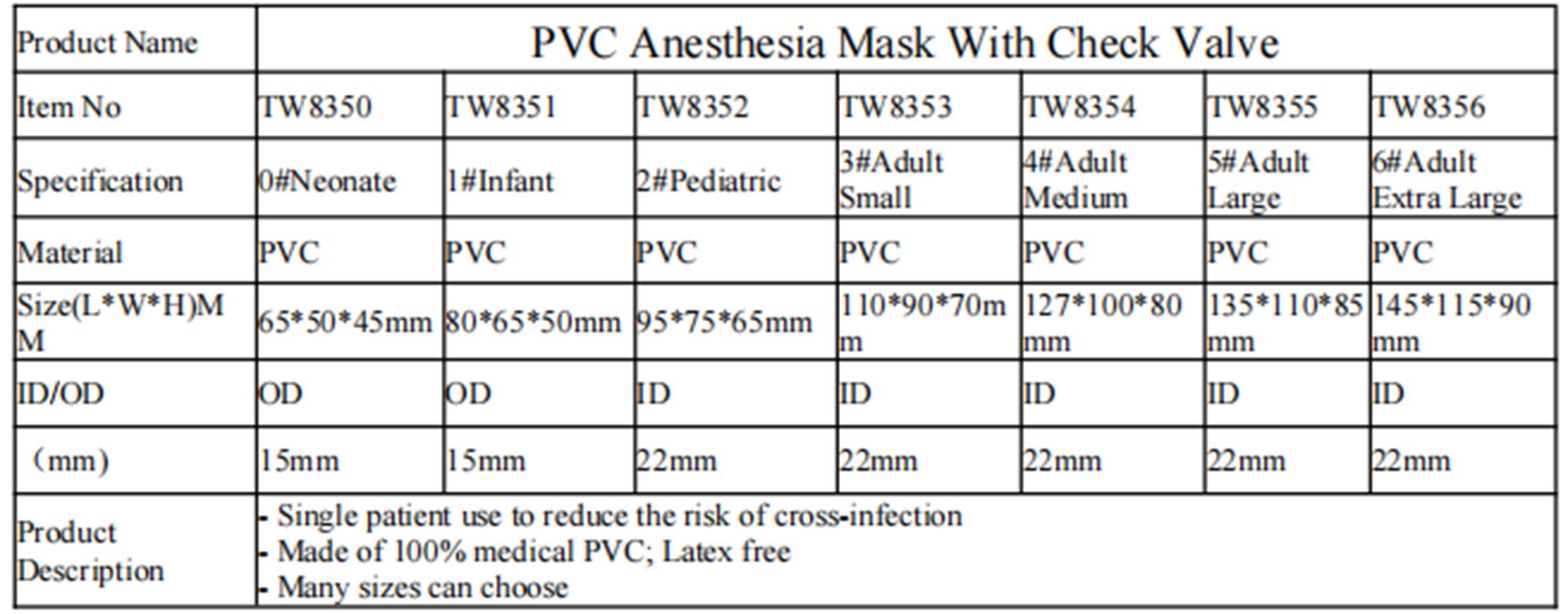
Sizing is the simplest guard against leaks. Masks run from neonate (size 0/1) through pediatric (2–4) to adult (5–6, sometimes up to 8). A practical bedside method: align the mask from the nasal bridge to the tip of the chin without compressing soft tissue, and seat the cushion on bony landmarks—avoiding the eyes and lips. Too small and you cannot seal; too large and dead space rises while visibility of the mouth drops. Stock the sizes your case mix actually needs: a general OR keeps #3–#5 plus a pediatric set; a neonatal unit narrows to #0–#1. Color-coded hook rings speed selection under stress.
PVC Single-Use vs Silicone Reusable
- PVC (single-use): economical, 100% latex-free, and disposed after one patient—which removes cross-infection risk. A soft, pre-inflated air cushion (as on our TW8374) molds to facial contours, so you reach a seal with less downward pressure. Individually packed and lot-traceable, it suits high-turnover theaters and EMS.
- Silicone (reusable): supple, autoclavable, and built to survive hundreds of cycles. The higher unit cost pays back in facilities with validated reprocessing and a steady case load. Best for training manikin sets and ORs that reprocess between patients.
A useful rule: "one patient, one mask" favors PVC; "one mask, many cycles" favors silicone.
Cushion, Connector, and Visibility
- Air cushion: an inflatable rim lets you fine-tune seal pressure and accommodate beards or edentulous faces. Over-inflating doesn't improve the seal—it just increases pressure marks.
- 22 mm connector: the standard port snaps onto anesthesia machines, ventilators, and bag-valve masks without adapters, which is exactly where disconnections usually happen.
- Transparent dome: you can see fogging, secretions, and lip color without lifting the mask—useful the moment induction deepens.
- Color-coded hook ring: speeds size selection under stress and doubles as a head-strap anchor.
What Distributors Should Check Before Sourcing
If you are evaluating suppliers for a tender or a private-label line, line them up on:
- Biocompatibility and latex-free certification (PVC should meet biocompatibility standards).
- Single-unit sterile packaging with size, lot, and expiry printed on each unit.
- A full size range (neonate to adult large) in one program, so you can offer mixed cartons.
- Documentation: CE, ISO 13485:2016, and FDA-listing support for export markets.
- Consistent cushion rebound and clean molding—ask for samples across two production batches.
Related Products
Why Partner With Tianzuo Medical
Xiamen Tianzuo Medical Co., Ltd. builds emergency, anesthesia, and respiratory products under one roof—R&D, molding, and production integrated, with OEM and ODM as our forte. We hold ISO 13485:2016, with CE and FDA-listed products, and our team drafted China's *Guidelines for the Technical Review of Manual Resuscitator Registration*—an engineering depth that carries into every mask we mold. For distributors and wholesalers, we support private-label branding, flexible MOQs, and export documentation packs (IFU, labeling, traceability) that satisfy tenders across Europe, the Middle East, and Asia. If you are building or refreshing an anesthesia consumables line, contact our experts for samples and pricing, or email Stephen@tzmed.com directly.
Frequently Asked Questions
What size anesthesia mask do I need for an adult?
Are PVC anesthesia masks latex-free?
Can anesthesia masks be reused?
What connector fits an anesthesia machine?
Does Tianzuo Medical offer OEM anesthesia masks?
- How to Use a Three-Ball Spirometer: A Practical Guide for Post-Surgery Breathing Recovery
- How to Choose a Head Immobilizer: A B2B Buyer's Guide for EMS and Hospital Procurement
- High-Flow Nasal Cannula (HFNC): How It Works and When to Choose It Over a Standard Oxygen Mask
- Nasal Oxygen Cannula: The Quiet Workhorse of Oxygen Therapy (and How to Spec It Right)
- Air Splint vs Plaster Cast: Which Immobilization Device Should You Choose?
- Venturi Mask vs Non-Rebreather Mask: Which Oxygen Delivery Device Should You Choose?
- Laryngeal Mask Airway (LMA) vs Endotracheal Tube: How to Choose the Right Airway
- How to Choose a CPAP Mask: Full Face vs Nasal vs Nasal Pillow (2026 Buyer's Guide)