

How Does an Anti-Choking Device Work? A Practical Guide for Clinics, Schools, and Distributors

Author
Experience the Xiamen Tianzuo Medical difference – where every product is a testament to our dedication to health and safety.
Tianzuo Medical


Summary: Choking is a leading cause of accidental injury death, yet the standard Heimlich maneuver isn't safe or effective for everyone—infants, the elderly, pregnant women, and people in wheelchairs included. An anti-choking device (also called a choking rescue or suction device) offers a non-invasive backup that uses negative pressure to pull a blockage free. This guide explains how it works step by step, how it compares with abdominal thrusts, who should stock one, and what distributors should check before sourcing.
Why Choking Rescue Devices Are Gaining Attention
In the United States, choking is the fourth leading cause of unintentional injury death, and for infants under one year it is the top preventable-injury killer. The Heimlich maneuver has saved countless lives since 1974, but it relies on rescuer strength and correct technique—and it can cause rib fractures or internal injury in frail patients. That gap is why schools, care homes, and restaurants are now adding suction-type rescue devices to their first-aid kits, and why several U.S. states have begun mandating them on school campuses.
How an Anti-Choking Device Works
The principle is simple: instead of pushing air in (like abdominal thrusts), the device pulls the obstruction out with suction. A typical unit—our TW8648 choke suction device follows this design—has four parts:
- Face mask: Placed over the nose and mouth to form an airtight seal.
- One-Way Valve: Stops air from being pushed further into the airway.
- Plunger / suction pump: Depress to clear air, then pull back to generate negative pressure.
- Transparent tube: Lets the rescuer see the dislodged object.
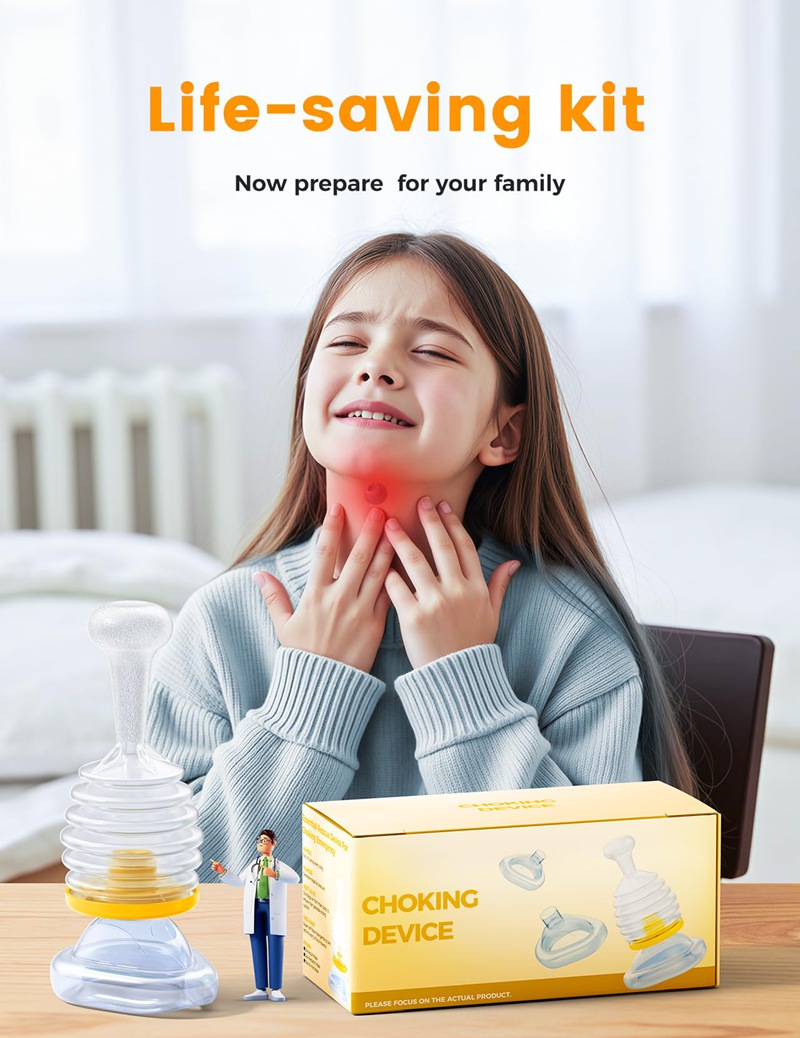
In use, you place the mask, press the plunger down to expel air, then pull it up to create suction. If the first attempt doesn't clear the blockage, repeat the push-pull motion without removing the mask. Most lay users can assemble and operate the device within roughly three minutes—inside the window before hypoxia causes harm.
Anti-Choking Device vs. the Heimlich Maneuver
They aren't competitors; they're layers of defense. Guidelines still put back blows and abdominal thrusts first. The device is the *second-line* option when those fail, or when the rescuer can't safely apply them—think a pregnant woman, a frail senior with osteoporosis, or an infant whose ribs are too delicate for thrusts. Because suction is gentler than compressions, it's also easier for an untrained bystander to attempt without causing injury.
One caveat distributors should communicate: these devices should supplement, not replace, standard first-aid training. Buyers should stock them alongside, not instead of, CPR and choking education.
Who Should Stock One
- Schools and daycare centers: Where young children choke most often.
- Care and nursing homes: For residents who can't tolerate abdominal thrusts.
- Restaurants and gyms: High-risk public settings with mixed-age crowds.
- Home and travel kits: Especially for families with infants or elderly relatives.
- Clinics and ambulances: As a documented backup in the airway algorithm.
What to Look for When Sourcing an Anti-Choking Device
If you're a distributor or procurement lead evaluating suppliers, check these points:
- Clear one-way valve and airtight mask seal — the core of safe operation.
- Transparent chamber so rescuers see the extracted object.
- Adult and pediatric mask options in one kit where possible.
- Simple, pictogram-based instructions for untrained users.
- Certifications and QC — work with a manufacturer running ISO 13485 processes and able to supply test documentation.
Related Products
Why Partner With Tianzuo Medical
As a vertically integrated manufacturer of emergency, anesthesia, and respiratory products, Xiamen Tianzuo Medical brings the same quality system to airway devices as to our flagship resuscitators: ISO 13485:2016, CE, and FDA-listed production, plus in-house molding and OEM/ODM support. For wholesalers and brand owners, we offer private labeling, flexible MOQs, and the documentation needed for tenders and retail compliance.
If you're adding choking rescue devices to your catalogue, reach our team for pricing, samples, and customization options, or email Stephen@tzmed.com.
Frequently Asked Questions
How does an anti-choking device remove a blockage?
Can it replace the Heimlich maneuver?
Is an anti-choking device safe for infants?
Do these devices require training to use?
Can Tianzuo Medical supply anti-choking devices under our brand?
- How to Use a Three-Ball Spirometer: A Practical Guide for Post-Surgery Breathing Recovery
- How to Choose a Head Immobilizer: A B2B Buyer's Guide for EMS and Hospital Procurement
- High-Flow Nasal Cannula (HFNC): How It Works and When to Choose It Over a Standard Oxygen Mask
- Nasal Oxygen Cannula: The Quiet Workhorse of Oxygen Therapy (and How to Spec It Right)
- Air Splint vs Plaster Cast: Which Immobilization Device Should You Choose?
- Venturi Mask vs Non-Rebreather Mask: Which Oxygen Delivery Device Should You Choose?
- Laryngeal Mask Airway (LMA) vs Endotracheal Tube: How to Choose the Right Airway
- How to Choose a CPAP Mask: Full Face vs Nasal vs Nasal Pillow (2026 Buyer's Guide)