PVC vs Silicone Resuscitators: Which Should You Choose?
Nov, 05 2026
PVC vs Silicone Resuscitators: Which Should You Choose?
Tianzuo Medical · Published November 5, 2026
F
in
IG
YT
In this article
Choosing between PVC, SEBS, and silicone manual resuscitators comes down to three variables: your reuse policy, your infection-control capacity, and total cost of ownership. This guide compares the three materials, shows how to size and stock a bag-valve-mask (BVM) set, and gives procurement teams a repeatable decision framework.
What a Manual Resuscitator Is — and Why Material Matters
A manual resuscitator — also called a bag-valve-mask (BVM) or Ambu bag — delivers positive-pressure ventilation when a patient is not breathing adequately. It is the fallback device on every code cart, ambulance, and ICU bay precisely because it needs no power and no battery. When advanced airway support is minutes away, the BVM is what keeps oxygenation going.
The bag material decides how the device behaves under stress: rebound feel, cleanability, and whether it is built for one patient or a thousand. At Xiamen Tianzuo Medical Co., Ltd. we manufacture all three mainstream options — PVC, SEBS, and silicone — across adult, pediatric, infant, and neonate sizes, all 100% latex-free.
Every BVM shares the same anatomy: a self-inflating bag, a non-rebreathing patient valve, a cushion mask, and usually an oxygen reservoir. The differences that matter in a real arrest are the bag's rebound, the valve's resistance, and the mask's seal — and all three are shaped by the base material. That is why the "PVC vs silicone" question is rarely about price alone; it is about which device fits your protocol, your volume, and your decontamination capability.
PVC Resuscitators — Disposable by Design
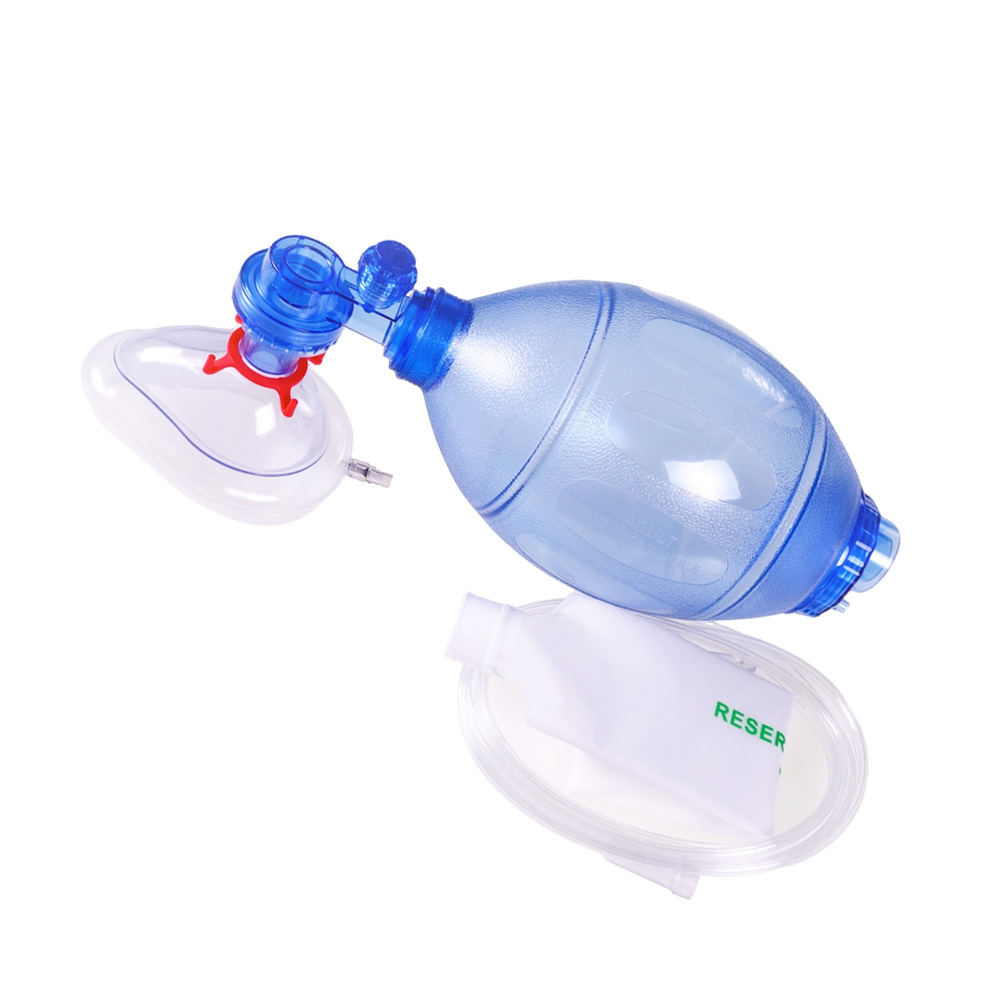
PVC (polyvinyl chloride) resuscitators are single-use by design. The bag arrives sealed, is used on one patient, and is discarded. That simplicity removes reprocessing entirely — the reason infection-control teams favor PVC for isolation rooms, code carts, and field EMS, where a device may sit unused for weeks before one call.
Our TW8311 Adult PVC Manual Resuscitator Ambu Bag is lightweight, cost-efficient, and 100% latex-free. The trade-off is lifecycle: a PVC bag is a per-event cost, not a capital asset. Choose PVC when your protocol mandates disposal after single use, or when reliable sterilization equipment is not available.
Fig. 1 — TW8311 Adult PVC Manual Resuscitator: a sealed, single-use BVM for code carts and isolation rooms.
Silicone Resuscitators — Built to Be Reused
Silicone is the durable counterpart. A silicone bag keeps its elasticity through repeated cleaning cycles, tolerates autoclaving, and offers the supple hand-feel clinicians prefer during long cases. The TW8111 Adult Silicone Manual Resuscitator is a reusable workhorse for hospitals and training programs with dedicated reprocessing.
The requirement is discipline: every reuse demands disassembly, high-level disinfection, and reassembly. Where volume is high and reprocessing is mature, silicone lowers per-use cost dramatically. For training departments that bag hundreds of times a week, silicone is usually the cheaper option over a year.
Silicone also holds its elasticity far longer than PVC, so the bag you train with in January feels the same in December. That consistency matters for muscle memory: clinicians who learn on a soft, predictable bag ventilate more reliably under stress.
Fig. 2 — TW8111 Adult Silicone Manual Resuscitator: reusable, autoclavable, soft hand-feel for repeated use.
SEBS — The Middle Ground
SEBS (styrene-ethylene-butylene-styrene) is a thermoplastic elastomer that splits the difference. It delivers silicone-like softness and elasticity at a lower material cost, and it is hypoallergenic — an important point for latex-sensitive settings. Our TW8211 Adult SEBS Manual Resuscitator suits distributors who want a reusable-feel device without the full silicone price.
Where silicone is over-spec and PVC is under-spec, SEBS is the pragmatic default. It gives procurement a third option that often lands exactly on the budget and performance line a mixed facility needs.
Because SEBS is hypoallergenic and tolerant of standard cleaning, it is a strong fit for pediatric and community settings where latex sensitivity is a live concern but a full silicone program is hard to justify.
Fig. 3 — TW8211 Adult SEBS Manual Resuscitator: the cost-balanced middle option between PVC and silicone.
A Decision Framework for Procurement Teams
We recommend scoring each setting on three axes before you place an order:
1. Reuse policy. Does your facility mandate single-use, or run validated reprocessing? Single-use → PVC; validated reprocessing → silicone or SEBS.
2. Volume. Sporadic use favors PVC; high daily volume favors silicone, which amortizes across many patients.
3. Infection-control capacity. No sterilization infrastructure → PVC; mature decontamination → silicone. This mirrors the framework buyers actually use: match the device to workflow, budget, and safety capacity — not to price alone.
A useful shortcut: map material to setting directly. Strict isolation or single-use mandate → PVC. High-volume ward with a validated reprocessing line → silicone. Mixed or cost-sensitive environment that still wants a reusable feel → SEBS. Most distributors we work with end up running a mixed fleet, and the framework above is how they justify the split to procurement.
Sizing and Stocking
A complete set covers four sizes: adult, pediatric, infant, and neonate. Mask mismatch is the most common leak source, so stock masks that match each bag and use color or size marks to cut hand-off errors during a code. A practical minimum for a mixed ward is one adult set with reservoir and PEEP, one pediatric set, and a sealed infant/neonate set. Add an optional TW8502 PEEP valve to the adult set so alveolar recruitment is available the moment a case calls for it. Standard connectors on the reservoir and oxygen tubing keep bag-to-oxygen transitions fast during a code.
We offer the full size range in every material. The silicone line, for example, spans TW8111 (adult), TW8121 (pediatric), TW8131 (infant), and TW8141 (neonate); the PVC line runs TW8311, TW8321, TW8331, and TW8341; the SEBS line covers TW8211, TW8221, and TW8231.
Total Cost of Ownership, Not Sticker Price
PVC looks cheaper per unit, but a high-turnover department may consume many bags a month. Silicone costs more upfront yet amortizes across many patients. SEBS lands between. The right answer is the one that minimizes total cost while meeting your infection-control standard — not the lowest unit price. Procurement teams that model cost per patient ventilated, rather than cost per bag, almost always land on a mixed fleet.
Related Products
TW8111 Adult Silicone Resuscitator
Reusable, autoclavable BVM for high-volume hospital use.
View product →
TW8311 Adult PVC Resuscitator
Single-use Ambu bag for code carts and isolation.
View product →
TW8211 Adult SEBS Resuscitator
Balanced reusable-feel option at lower material cost.
View product →
TW8502 PEEP Valve
Optional PEEP port to maintain alveolar recruitment.
View product →
Why Partner With Tianzuo Medical
Xiamen Tianzuo Medical Co., Ltd. is an ISO 13485:2016-certified manufacturer of manual resuscitators and respiratory devices, with CE-marked and FDA-listed product lines supplied to distributors across the USA, Europe, Southeast Asia, and Australia. Every BVM we produce is 100% latex-free and built to a consistent, factory-direct specification.
We support OEM/ODM programs with low minimum order quantities, full documentation packs, and direct factory pricing — so procurement teams get predictable lead times without middleman markup. Whether you need a single material across all sizes or a mixed PVC/SEBS/silicone fleet, our team will help you specify the right configuration.
Talk to our team about volume pricing and customization: contact us or email Stephen@tzmed.com.
Frequently Asked Questions
What is the difference between PVC, SEBS, and silicone resuscitators?
PVC is single-use and discarded after one patient, ideal for strict infection control. Silicone is reusable and withstands repeated cleaning and autoclaving, lowering long-term per-use cost. SEBS offers silicone-like softness at lower material cost, sitting between the two.
Are Tianzuo resuscitators latex-free?
Yes. All our manual resuscitators — PVC, SEBS, and silicone — are 100% latex-free, which reduces allergy risk for patients and clinicians during airway management.
Which manual resuscitator is best for single-use protocols?
PVC models such as the TW8311 adult and TW8341 neonate are designed for single-patient use. They remove reprocessing entirely and suit isolation rooms, code carts, and EMS without sterilization equipment.
Can silicone resuscitators be autoclaved?
Reusable silicone resuscitators like the TW8111 tolerate repeated cleaning and autoclaving. Follow the IFU: disassemble, high-level disinfect or autoclave, reassemble, and function-check before the next patient.
What sizes should a clinic stock?
Stock adult, pediatric, infant, and neonate sizes with matching masks to prevent leaks. A practical minimum is one adult set with reservoir and PEEP, one pediatric set, and a sealed infant/neonate set.
PVC Resuscitator
Silicone Resuscitator
Manual Resuscitator Buying Guide