Laryngeal Mask Airway (LMA) vs Endotracheal Tube: How to Choose the Right Airway
Sep, 01 2026
In this article
Choosing between a laryngeal mask airway and an endotracheal tube comes down to one question: how much airway protection and ventilation pressure does the patient actually need? The LMA is a supraglottic device placed above the vocal cords; the ETT is an infraglottic tube that seals inside the trachea. This guide breaks down when each wins, so procurement teams and clinicians can stock and specify the right tool.
What Is a Laryngeal Mask Airway (LMA)?
A laryngeal mask airway is a supraglottic airway device. It consists of a flexible tube with an elliptical, inflatable cuff at the distal end. The clinician inserts it blind — no laryngoscope, no direct view of the cords — and seats the cuff over the laryngeal inlet, where it forms a low-pressure seal around the top of the larynx. Air is channeled toward the lungs without ever passing through the vocal cords.
Since its clinical introduction in the 1980s, the LMA has become a staple of ambulatory and short-procedure anesthesia. First-attempt insertion success routinely exceeds 95% in trained hands, and because the device never enters the trachea, it spares the patient the airway trauma associated with intubation.
What Is an Endotracheal Tube (ETT)?
An endotracheal tube is an infraglottic device. After induction, the provider uses a laryngoscope to visualize the vocal cords and passes a cuffed tube through them into the trachea. Inflating the distal cuff creates a tight, definitive seal against the tracheal wall. That seal is what makes the ETT the gold standard whenever absolute airway isolation matters.
The Core Difference That Drives the Decision
The single most important distinction is where the seal sits. An LMA seals *above* the glottis; an ETT seals *inside* the trachea. That anatomical gap determines three things buyers and anesthesiologists care about:
Aspiration protection. Only the ETT truly isolates the lungs from the esophagus. An LMA offers low-to-moderate protection at best.
Pressure tolerance. An ETT holds up under high positive-pressure ventilation. An LMA cuff can leak when airway pressures climb above roughly 25 cmH₂O.
Invasiveness. The LMA is gentler on teeth, vocal cords, and mucosa, which translates into fewer sore throats and a faster emergence.
In plain terms: the ETT is the safer choice when the stakes are aspiration or high-pressure ventilation; the LMA is the smarter choice when you want speed, comfort, and a lighter physiological footprint.
When an LMA Is the Better Choice
Reach for an LMA in scenarios such as:
Short to medium elective surgeries (under roughly two hours) where the patient can breathe spontaneously or with light support.
Ambulatory and day-surgery units, where faster recovery and lower postoperative nausea directly improve throughput.
Rapid airway establishment in settings where laryngoscopy expertise or equipment is limited — the blind insertion technique keeps time-to-ventilation short.
Patients at low aspiration risk with normal anatomy and no full-stomach concern.
Because insertion does not require deep neuromuscular blockade, the LMA also reduces drug load and shortens the recovery window — a real operational advantage for high-turnover operating rooms.
When the Endotracheal Tube Wins
Specify an ETT when any of these apply:
Full stomach, pregnancy, severe GERD, or obesity — anywhere regurgitation risk is elevated, the tracheal seal is non-negotiable.
Prolonged or complex procedures, especially abdominal, thoracic, or prone-position surgery where tube security matters.
High ventilation pressures or poor lung compliance, where an LMA cuff would simply leak.
Airway itself is the surgical field, or substantive airway obstruction is present.
The ETT remains the default for critical-care and emergency definitive airway control. No supraglottic device replaces it there.
Materials and Single-Use Considerations for Buyers
From a procurement standpoint, LMAs and face masks come in reusable silicone and single-use PVC or PVC-free formats. Single-use devices remove sterilization load, eliminate cross-contamination risk, and simplify inventory in busy ORs and EMS settings. For facilities running tenders or distributor programs, confirming CE, ISO 13485, and FDA documentation up front prevents delays at customs and during hospital qualification.
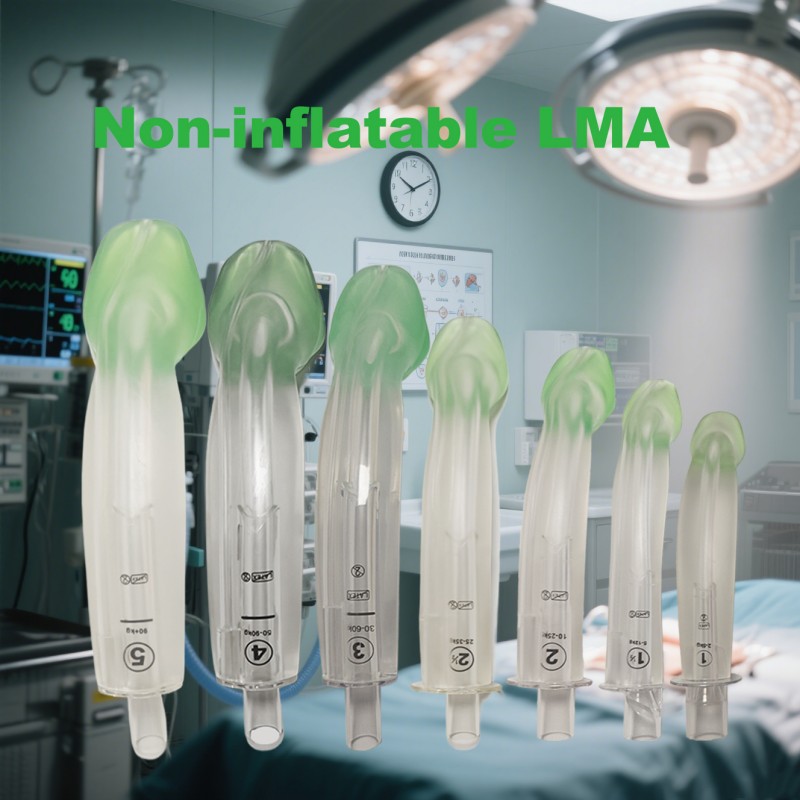
Sizing is another practical detail distributors should not overlook. LMAs are supplied across a size range — typically size 1 for neonates up through size 5 for large adults — and a mixed stock is the only way to cover a real patient census. Cuff volume matters too: over-inflation causes mucosal ischemia, so procurement specs should match cuff capacity to the sizes a facility actually uses rather than buying on price alone.
Tianzuo Medical does not manufacture the LMA itself, but the device is almost never used alone. It sits inside an anesthesia workflow that depends on compatible masks, seals, and backup ventilation — exactly the category of consumables a B2B buyer needs to source alongside any airway program.
Choosing for Your Facility
Map the decision to your case mix. High-volume day surgery with low-risk patients → favor LMAs and the consumables around them. Mixed or high-acuity hospitals → keep ETTs and full airway carts stocked. Most facilities run both, which is why a reliable manufacturer partner who can supply masks, resuscitators, and related disposable airway hardware on consistent lead times is worth more than a one-line product discount.
One more operational point: the LMA lowers the skill floor for airway establishment, but it does not remove the need for credentialing. Any facility adopting it should pair the device with a clear failed-airway protocol and a ready backup — usually a bag-valve mask and, when indicated, a supraglottic-to-ETT escalation plan. Specifying the consumables for that backup kit is part of the same procurement conversation.
Related Products
PVC Anesthesia Masks with Ultra-Soft Cushion (TW8374)View product →Resuscitation Mask with One-Way Valve (TW8342)View product →Adult Silicone Manual Resuscitator (TW8111)View product →Adult PVC Manual Resuscitator / Ambu Bag (TW8311)View product →Adult SEBS Manual Resuscitator (TW8211)View product →
Why Partner With Tianzuo Medical
Xiamen Tianzuo Medical is a one-stop manufacturer integrating R&D, molding, and production of emergency, anesthesia, and respiratory consumables. Our strength is OEM / ODM: we support private-label programs, distributor exclusivity, and bulk orders with flexible MOQ for wholesalers and procurement teams worldwide. Every production line runs under ISO 13485:2016 with CE and FDA registration, and our team helped draft China's technical review guidelines for manual resuscitators — a measure of the engineering depth behind the products.
Whether you are equipping an OR, an EMS crash cart, or a tender bid, we deliver consistent quality, export documentation, and responsive lead times. Talk to our team about your airway and ventilation program:
Inquiry page: https://www.tianzuomedical.com/contact-us
Email: Stephen@tzmed.com
Frequently Asked Questions
Is an LMA the same as intubation?
No. Intubation means passing a tube through the vocal cords into the trachea (an ETT); an LMA sits above the cords and is documented as supraglottic airway placement, not intubation.
Which device causes less sore throat after surgery?
The LMA. Because it never enters the trachea, postoperative sore throat and hoarseness rates are markedly lower than with an endotracheal tube.
Can an LMA be used for high-pressure ventilation?
Only limited. The cuff may leak above roughly 25 cmH₂O, so patients needing high airway pressures should be managed with an ETT.
When is an ETT mandatory over an LMA?
When aspiration risk is high (full stomach, pregnancy, severe GERD, obesity), for prolonged or prone surgery, or whenever tight airway isolation is required.
Are LMAs available as single-use devices?
Yes. Many are supplied pre-sterilized in medical-grade PVC or silicone for single use, which removes sterilization burden and cross-contamination risk in high-turnover settings.