How to Choose a Manual Resuscitator (BVM): A Practical Buying Guide for Clinics, Distributors, and First Responders
Aug, 05 2026
Summary: A manual resuscitator—often called a BVM or Ambu bag—is the fallback device that keeps a patient breathing when a ventilator isn't available. This guide walks procurement managers, distributors, and clinical buyers through the three core material choices (PVC, silicone, SEBS), how to size bags for neonate through adult patients, the specifications that actually matter on the spec sheet, and when single-use beats reusable. We also cover how to vet an OEM/ODM manufacturer so your order meets ISO 13485, CE, and FDA expectations.
What a Manual Resuscitator Does—and Why It's Still Essential
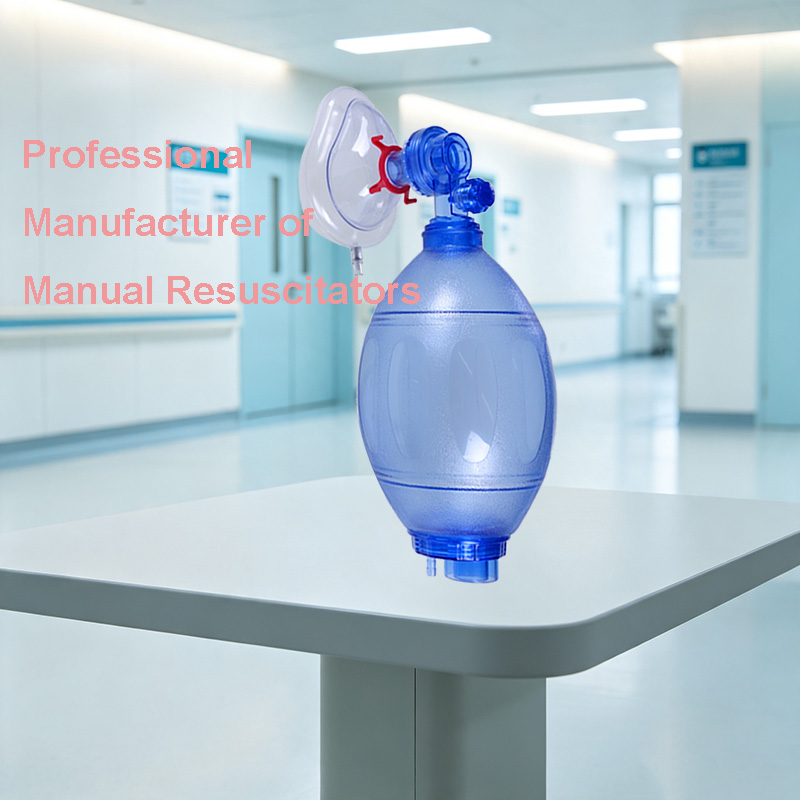
Electric ventilators do the heavy lifting in the ICU, but they fail exactly when you can least afford it: during a power cut, a transfer down the corridor, or the first three minutes of a cardiac arrest in the field. A manual resuscitator is the hand-squeezed bag that bridges those gaps. Squeeze the self-inflating bag and a one-way patient valve pushes air—or oxygen from the reservoir—into the lungs; release it and the bag refills, ready for the next breath.
Because it needs no power, no software, and almost no training to operate at a basic level, the BVM stays on every ambulance, outside every operating theatre, and inside every crash cart. If you are buying for a hospital, a distributor, or a government tender, the device you choose has to perform the same way on attempt 500 as on attempt one.
PVC, Silicone, or SEBS: Picking the Right Material
This is the first real decision, and it shapes cost, cleaning, and shelf life.
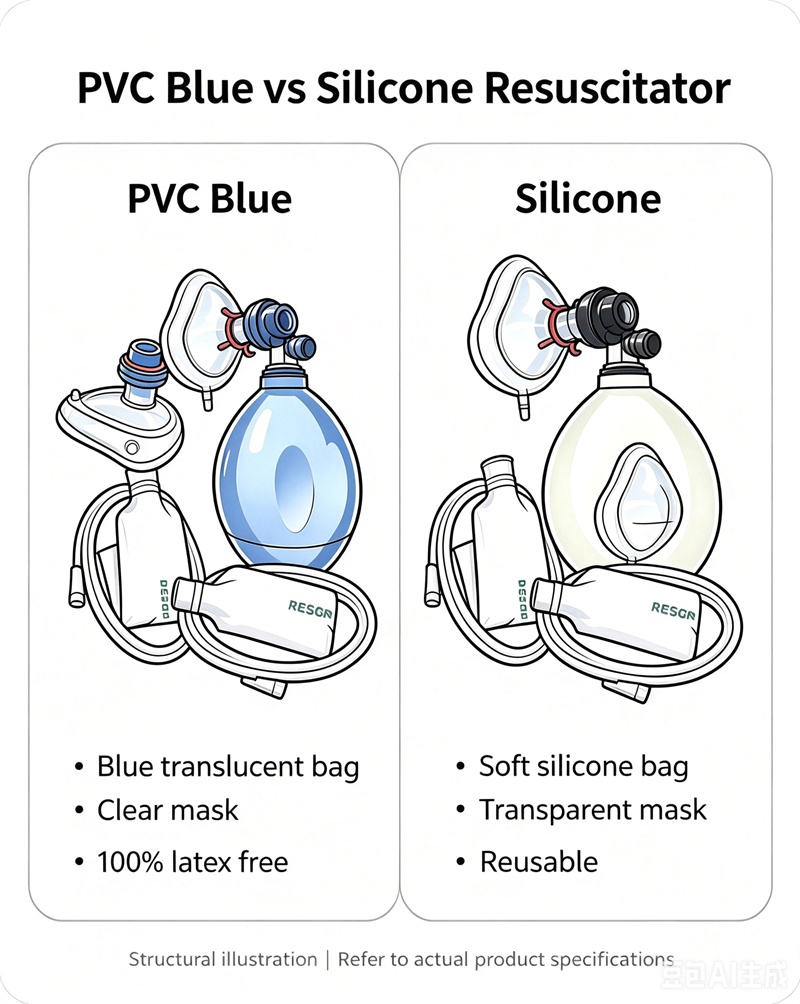
PVC (single-use): The workhorse for EMS and high-turnover settings. PVC bags are economical, 100% latex-free, and disposed after one patient, which removes cross-infection risk. Our TW8311 adult PVC resuscitator, for example, ships with a built-in pressure-limiting valve and a 2,000 ml reservoir bag.
Silicone (reusable): Supple, autoclavable, and built to survive thousands of cycles. Silicone keeps its elasticity after repeated disinfection, so it is the default for theatres and training programs. The trade-off is a higher unit price and a validated reprocessing step.
SEBS (single-use, cold-resistant): A thermoplastic elastomer that stays flexible in low temperatures and is more environmentally friendly than standard PVC. It is a strong pick for pre-hospital kits in cold climates.
A useful rule: if your protocol is "one patient, one device," PVC or SEBS wins; if you are ventilating the same bag across a shift or a semester, silicone pays for itself.
Sizing the Bag: Neonate to Adult
Ventilation volume has to match the patient. Over-bagging an infant causes barotrauma; under-bagging an adult wastes the effort. Standard ranges from our technical sheet:
Neonate (0#): ~250 ml bag volume
Infant (1#): ~340 ml
Pediatric (2#): ~680 ml
Adult (4#): ~1,630 ml
Stock the sizes your population actually needs. A mixed emergency department usually carries adult, pediatric, and infant sets with matching masks; a neonatal unit narrows to 0# and 1#. Color-coded masks cut hand-off errors when seconds count.
Spec Sheet Checkpoints That Matter
Before you place a bulk order, line up suppliers on these points:
Pressure-limiting valve: 40 cmH₂O for pediatric/infant, 60 cmH₂O for adult—prevents over-inflation.
Dead space: Lower is better; our patient valve sits at ~7 ml.
Resistance: Inspiratory and expiratory resistance under 5 cmH₂O keeps fatigue down during long cases.
Connectors: Standard 15 mm / 22 mm fittings so the bag works with your masks and circuits.
Reservoir and PEEP readiness: A reservoir bag (1,600–2,000 ml) and an optional PEEP port protect oxygenation when it counts.
Single-Use vs. Reusable: Matching Workflow
Single-use bags simplify infection control and need no reprocessing line—ideal for distributors serving EMS and disaster-response stockpiles. Reusable silicone suits facilities with validated cleaning and a steady case load. Most buyers end up with a mix, and that is fine.
Related Products
Adult Silicone Manual Resuscitator (TW8111)— reusable, autoclavable, 1,630 ml.View product →Adult PVC Manual Resuscitator / Ambu Bag (TW8311)— single-use, 100% latex-free.View product →Adult SEBS Manual Resuscitator (TW8211)— cold-resistant, eco-friendly single use.View product →PVC Anesthesia Masks with Ultra Soft Cushion (TW8374)— pair with any BVM circuit.View product →Resuscitation Mask with One-Way Valve (TW8342)— CPR and emergency ventilation.View product →
Why Partner With Tianzuo Medical
Xiamen Tianzuo Medical Co., Ltd. is a one-stop manufacturer integrating R&D, molding, and production under one roof—OEM and ODM are our forte. We hold ISO 13485:2016, with CE and FDA-listed products, and our team actually drafted the *Guidelines for the Technical Review of Manual Resuscitator Registration* in China. That engineering depth shows up in details distributors care about: consistent bag rebound, clean valve design, and color-coded sizing that reduces clinical error.
For procurement teams and wholesalers, we support private-label branding, flexible MOQs, and documentation packs (IFU, labeling, traceability) that satisfy tenders across Europe, the Middle East, and Asia. If you are building or refreshing a resuscitation product line, contact our experts for a quote and sample kit, or email Stephen@tzmed.com directly.
Frequently Asked Questions
What is the difference between a manual resuscitator and a ventilator?
A ventilator is powered and automated; a manual resuscitator is hand-squeezed and needs no power, making it the backup and first-response device.
Is a silicone or PVC resuscitator better?
Neither is universally better. PVC and SEBS suit single-use, high-turnover settings; silicone suits reusable, multi-patient workflows where cleaning is validated.
What size manual resuscitator do I need for an adult?
Typically a 4# adult bag around 1,500–1,630 ml with a 60 cmH₂O pressure-limiting valve and a matching adult mask.
Can Tianzuo Medical produce manual resuscitators under our brand?
Yes. We provide OEM/ODM services including molding, branding, and compliant documentation for international tenders.
Are your manual resuscitators latex-free and certified?
All our resuscitators are 100% latex-free and manufactured under ISO 13485:2016, with CE and FDA listing where applicable.
Published by Tianzuo Medical · tianzuomedical.com · Emergency, Anesthesia & Respiratory products since 2011.